

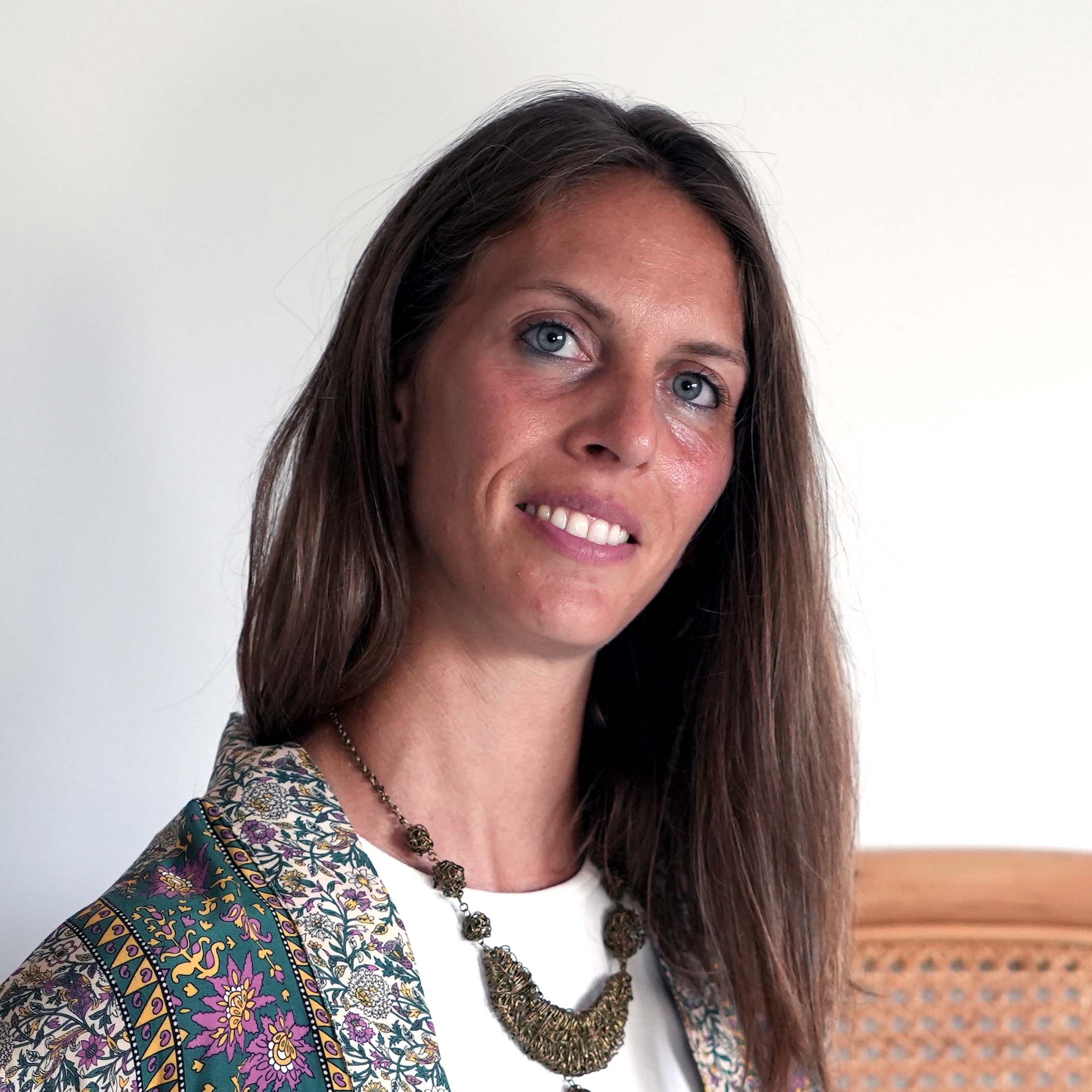
"I learned that in some Indigenous cultures, when a sick person goes to a healer, the first question they are asked is, "when did you stop singing and dancing?" There’s a lot of truth in this question. When did we lose our joy for life? What if joy is the way out? I believe this is the work we have to do."
Federica Lari, Planetary Health Yoga
Federica Lari is a cell biologist, certified Hatha yoga teacher, and faculty member of contemplative-based resilience (CBR) at the Garrison Institute in New York, where she facilitates training in mind-body contemplative practices to support the well-being of helping professionals. She holds a PhD from the University of Oxford, 10 years of research experience in the biomedical sector, and a certificate in sustainability management, which culminated in service with the New Jersey government as a science advisor on climate change. In 2023, she founded Planetary Health Yoga, a holistic approach to well-being that integrates mindful movement, breathing practices, meditation, relaxation techniques, and nutrition to help people develop their inner capacities as a foundation for their physical and mental health.
Q: Tell me about the work you do in the world.
Federica Lari (FL): At its core, my work is about inviting people to rediscover their own humanity—and in doing so, I am rediscovering mine. It’s a shared journey that we are walking together! This project started as my personal response to what I had been witnessing working on climate change and sustainability in New Jersey’s government: the realization that at the root of the polycrisis we face—ecological, social, political, and personal—lies our profound disconnection from nature.
If disconnection is the root, then healing this relationship must be the solution. The work I do now is focused on reconnecting with ourselves, with the natural world, and with the deeper wisdom that lives within and around us.
Q: Such a beautiful perspective! I’d love to hear more about how you support people in “reconnecting” in practice?
FL: Currently, I offer a six-week in-person program called Reconnect. It’s a self-discovery journey that integrates yoga, mindfulness, and my scientific background in biology. Each week we explore a different layer of being, gradually moving from the outer world to our inner core. Being physically together is a crucial part of the experience, catalyzing and supporting our healing journey.
We begin with the body—through yoga and mindful movement, we learn to inhabit our physical self, regulate our nervous system, and reconnect mind and body. In the second week, we focus on the breath, using pranayama practices to connect with our life force. The third week is devoted to food—not just as sustenance, but as a sacred communion with the Earth. We explore how food affects our mood, health, and energy, integrating wisdom and knowledge from the East and the West, with influences ranging from Ayurveda to the planetary health diet.
In the fourth week we turn inward, using practices like yoga nidra to observe our mind and beyond. We begin to understand that we are not our thoughts—we can in fact witness them without being swept away. In week five, we introduce a meditation technique that participants can easily carry into daily life. It’s about training our capacity to cultivate awareness and resilience and acquiring tools that can help us lead a more intentional and harmonious life.
Finally, in week six, we integrate it all with the concept of “interbeing,” drawn from Buddhist tradition. We explore our deep interconnectedness with all of life. We are all part of an ongoing infinite story that comes from our ancestors and continues long after we have gone. This realization can bring a profound sense of belonging and meaning—something many of us have lost.
These six weeks can be thought of as the spark of our healing journey, a foot in the door of understanding that there is a pathway to restore harmony and find a larger purpose for our place in the world.
Q: What inspired the creation of Planetary Health Yoga?
FL: Since I was a child I have had a strong environmental conscience and love for nature. Late in my career as a cell biologist, my concern for the ecological crisis started to rise, spurring my transition to sustainability. I thought of climate change as a scientific and political problem, so I decided to become a government advisor. But it began to feel like putting a Band-Aid on a broken leg. We weren’t asking the deeper question: Why are we in crisis? I realized we were applying solutions without understanding the root cause—treating symptoms rather than the source. It was then when the seeds for Planetary Health Yoga were planted. As I more deeply understood the roots of our behaviours, I started to imagine ways to create solutions aligned with the laws of nature—and our true nature—rather than opposing it.
Earth is responding to what we have done; she is merely adapting, not collapsing. I believe that if we stop the assault on the Earth, she will return to some sort of dynamic equilibrium. Following my work in the government, I enrolled in a course called Zen and the Art of Saving the Planet by Plum Village, and then I trained to become a yoga teacher. Yoga teaches us a way of living in peace and harmony with the whole of nature. Integrating yoga, biology, and ancient wisdom traditions in a way that feels relevant for today’s challenges, we can restore balance within ourselves, which in turn impacts all our relationships. Shifting how we think, eat, and relate to each other and toward the natural world can have powerful ripple effects. So by healing the individual, we begin to heal the entire web of life that we are part of. As a collective, we have been on a phenomenal journey of learning what it means to be human. We went to the moon, and now we need to go inside!
Q: How did your personal practice evolve during this time? What role has yoga and the yogic path played in your journey?
FL: I have been a yoga practitioner since my late twenties. During my work in climate policy, I maintained a strong meditation practice. It was my lifeline. The more I worked in systems designed to measure, control, and intervene with nature, the more I realized that nature knows what to do. The planet doesn’t need more interventions, it needs more conscious humans—we need to shift the conversation from climate change to human change.
I fell into depression when I began to fully grasp the scale of the crisis. Yoga was the ladder that helped me climb out. It’s a heart-opening practice, and it gave me the tools to restore my hope. I still practice daily—yoga, meditation, and sometimes simply breathing with awareness.
Today I teach to share this powerful gift with others. Witnessing my students benefitting from the practice brings me infinite joy and a much more optimistic outlook into the future. I don’t have the answers to solve climate change, but I think consciously realigning ourselves with nature is at the core of all other solutions.
Q: How do you envision scaling this work to a broader audience?
FL: Everyone wants scalable solutions—but nature doesn’t work that way. There are seasons of rest, incubation, and integration. We need to slow down and do the inner work, even if it doesn’t yield instant results. True transformation takes time, and it’s challenging to recognize this in the face of the urgency of climactic shift.
I do believe this work can grow. I’m especially interested in bringing it into education—imagine if reconnecting with ourselves and nature was integrated into our basic educational curriculum? What would that do in just a couple generations? I see a strong potential in early childhood education.
Children are naturally curious and they’re starving for awe and wonder in nature. If we can support that, rather than suppress it, we can raise a generation that is deeply connected and resilient.
I once ran a nature mindfulness camp for 11-year-olds. We hiked, practiced mindful eating and walking, and connected with the forest. The kids were astounded by the smell of the soil—some had never experienced that! What if we could rebuild education around curiosity, connection, and a genuine relationship with life. Learning in a joyful and embodied way.
I do see my work being brought into schools and academia, where it has the potential to create powerful ripple effects. Along with contributing to the creation of more conscious generations, it will also help them navigate challenging emotions like eco-anxiety and eco-grief which are rapidly growing concerns.
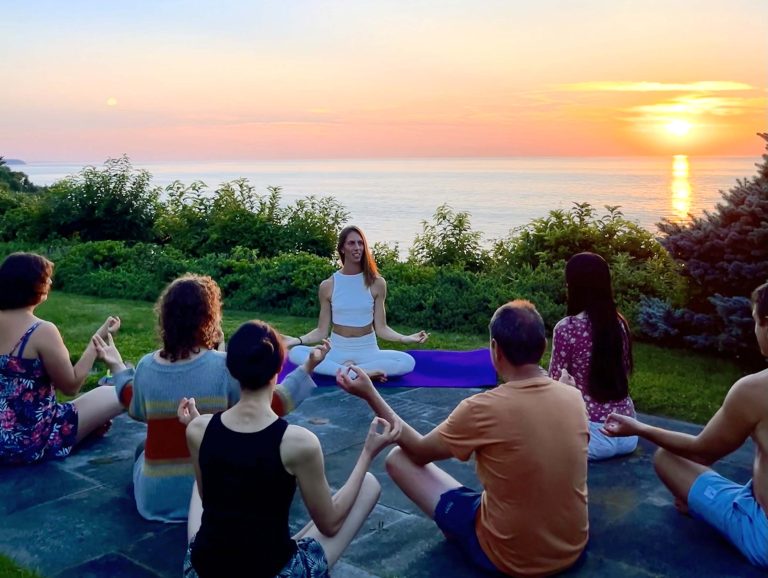
Federica’s yoga programming invites people to rediscover their own humanity, and, in doing so, reconnect with the deeper wisdom that lives within and around us.
Q: What do you see as some of the primary challenges we collectively face today?
FL: We are a culture of many “successful” people who are deeply disconnected from what they love—I think this is a big part of the mental health crisis, being divorced from one’s purpose. Without a sense of purpose, someone might seek fulfillment in unhealthy places as a way to fill the void, such as addiction and overconsumption.
To cite a great thinker of our times, we can’t solve a problem using the same mindset that created it (Albert Einstein!). The greatest barrier to change is our own mindset and values. As long as we define success through material wealth we will keep falling into the hole. Our health and the health of our planet are our greatest wealth. Without these, we are weak, debilitated, and unable to prosper. Our well-being and the one of the ecosystems we live in must become our primary marker of success. Yet our systems are so deeply embedded with a contrary message, which makes it challenging to step outside these norms.
I believe that a strong grassroots movement can eventually shift the whole system, and that starts with us. It’s not just about intellectually adopting new values, we need to embody them in our way of living so we can be of inspiration for others. I try to live the Reconnect teachings to the best of my ability. We can all become that light in the darkness! I have no regrets for letting go of my academic status to embrace a simpler life where I have more time to take care of myself and my family, cook healthy and nutritious food, spend time outside, cultivate presence and inner peace, and support others to do the same. I went from seeking outcomes and results to enjoying every step of the journey, and in the process I discovered incommensurable value and fulfillment.
Q: How has your scientific background informed your approach to teaching?
FL: I bring in what I know from biology and biomedical research—how our cells function, how the body and mind work together, how food affects our physiology, how stress impacts our cells. My strong foundation in human biology helps me discern what is relevant for our health and how a certain intervention can affect a certain outcome. The scientific method helped me develop a pragmatic approach to teaching using clear and concise language that feels relatable, and using critical thinking in tandem with my intuition and other ways of knowing.
At the same time, the scientific method is quite rigid and can create a mental cage that doesn’t spur creativity and radical innovation. We are taught to think outside the box, but we’re also imparted many postulates that “shouldn’t be challenged” so it becomes tricky to evolve. Part of my work is navigating between what still stands true and what no longer applies, for instance the old notion of genetic determinism is being disproven by epigenetics, with implications ranging from “we are what we eat” to “we are what we think,” meaning that we have a much stronger influence over our genetic expression than we thought we had.
I hope my scientific background will serve me in bringing these practices into academia, where a more integrated approach to health is urgently needed.
Q: Tell me about your role as a faculty member in contemplative-based resilience at the Garrison Institute.
FL: I’ve been part of the Garrison Institute since 2023. The contemplative-based resilience (CBR) program is an offering for professionals in the humanitarian, health, and social sectors that provides training in contemplative practices to help build resilience and support mental health. In serving others, too often helping professionals forget to serve themselves first. As they say, “Be well to serve well.” The format can vary depending on the audience, from single-day workshops to multi-week programs, and can involve a range of somatic and contemplative techniques, from yoga, mindfulness, meditation, nature therapy and more, all aimed at developing awareness, self-compassion, and grounding skills.
Q: What is your dream for Planetary Health Yoga? Where do you find hope?
FL: My dream for Planetary Health Yoga is that it will help shift the paradigm toward an acknowledgement of our interconnection with the whole of life and an understanding of planetary health as a foundational value. As I said, I see my direct contribution in the academic space, particularly amongst life scientists. Imagine if scientists could see through their heart and use their brain as a humble servant. We would witness a new renaissance not only in science, but in the whole of society.
Part of this work is already happening. There’s an increasing demand for finding purpose and a deeper meaning, probably exactly as a response to the existential threat that we’re facing.
We are living through what I see as both a cultural and spiritual crisis, but also a spiritual awakening. Despite the challenges, I believe we are forming islands of coherence—communities and initiatives that are connecting and slowly driving systemic change. Witnessing how rapidly these initiatives are growing gives me much hope and optimism. Along with this, my daily practice is really what keeps me going. Yoga and meditation have been my ladder out of the hole I fell into when I first confronted the gravity of the climate crisis. These heart-opening practices helped me broaden my perspective and see the light. Some days are still harder than others—those are the days my practice yields the most important fruits, keeping me grounded rather than being swept away by negative news.
I see signs of this awakening at every level, from grassroots movements to high-level discourse. I have made peace with the fact that we may lose this current civilization, but in that loss lies space for something new to emerge. While this reality brings grief, it also brings hope and trust that better things may arise from the lessons we are learning.
Q: What advice do you have for people feeling unfulfilled in their careers?
FL: If you often have an underlying sense of your own lack of fulfillment, start questioning. It’s never too late to find something that makes your heart smile. Practice deep listening and self inquiry—through meditation, journaling, vision quests, birth charts—whatever resonates. Finding a job that is also our life mission is inherently gratifying. It doesn’t mean it will be easy, but it will feel right.
When our work aligns with our values and passions, we find the strength to push back against barriers and societal pressures. Challenges become opportunities for growth. We stop chasing outcomes and start enjoying the journey. When we develop a strong connection with ourselves, our inner voice becomes our compass: we learn to trust it and we are guided by it, so little by little, the path begins to appear, one step at a time. It certainly takes some courage, but the reward is that we start living our dream!
Q: What do you see as the path to both individual and collective healing in this mental health crisis?
FL: The answer is complex because it’s a multi-factorial problem. Perhaps we can start looking for an answer by asking what has led us into this mental health crisis. It’s hard for everyone to keep up with the speed of the civilization we have created. We are constantly running on a treadmill, while naturally we are meant to live through cycles of activation and rest. Nature teaches us that infinite growth is not possible: a growing season is followed by a resting period. This time allows for regeneration, but we never give ourselves this time. In a way, we fell victim to our own progress. If we look at the natural world, we can learn how to live in a more regenerative way. Rather than constituting the source of the problem, our economic model and technological improvements need to respond to our real needs as human beings.
At the individual level, I fail to see how Western medicine alone, being mostly concerned with managing and suppressing symptoms, can restore our mental fabric. While it can be life-saving, it can fail to address the roots of many problems. To heal means to become whole. So how do we become whole? The answer is somewhere where science meets spirituality. In my view, by reconnecting with ourselves and the wisdom of nature. We need to find our lost compass. What I offer is only one of the many possible paths. This body contains the whole universe and our potential is immense. Ancient wisdom traditions can help us remember our true nature. Plant medicine, ceremonies, and rituals are receiving great interest for their power to unlock our subconscious and heal past trauma. Research is also proving psychedelics to be impactful on many mental health conditions, an example of integration between traditional and modern medicine.
I learned that in some Indigenous cultures, when a sick person goes to a healer, the first question they are asked is, “when did you stop singing and dancing?” There’s a lot of truth in this question. When did we lose our joy for life? What if joy is the way out? I believe this is the work we have to do.
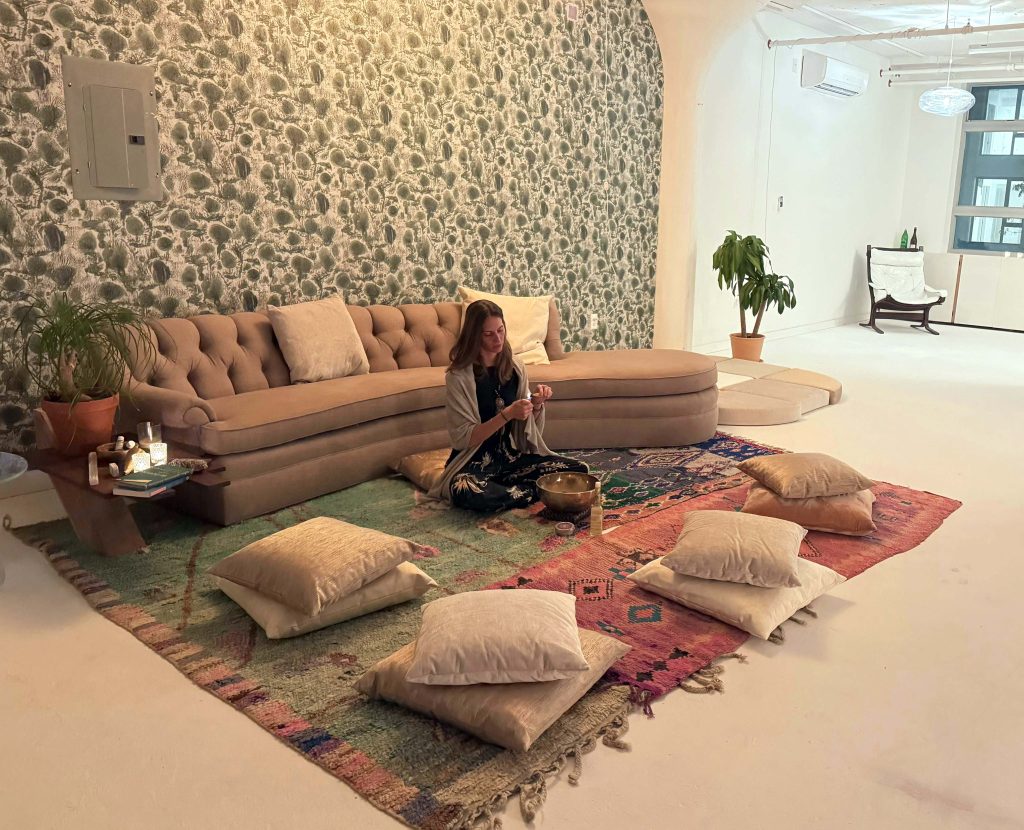
Through yoga programs that combine mindfulness, science, and the model of “interbeing,” Federica helps people reconnect with themselves and natural systems to gain deeper understanding of our inherent interconnectedness.
This interview is part of the Nova Institute for Health’s Insight Collaborative for Mental Well-Being project. The Insight Collaborative is supported by a generous seed grant from the Mental Insight Foundation.
Responses